Tail Light Harness Replacement Guide for 1960–1965 Falcon, Ranchero, and Comet Wagons

Why This Job Matters

This isn’t just about lights—it’s about safety and reliability. A fresh harness eliminates voltage drops, intermittent faults, and those “works when it feels like it” gremlins. It’s one of those upgrades that doesn’t show at the car show, but you’ll feel it every time you drive.

Tail Light Harness Replacement Guide for 1960–1965 Falcon, Ranchero, and Comet Wagons

Tail Light Harness Replacement Guide for 1960–1965 Falcon, Ranchero, and Comet Wagons

If your rear lights are acting like they’ve got a mind of their own—dim, intermittent, or just plain dead—there’s a good chance your tail light harness has seen better decades. On these early ‘60s Fords, wiring lives a hard life: heat, moisture, corrosion, and time all take their toll. Replacing the harness isn’t glamorous work, but it’s one of those fixes that restores confidence every time you hit the brakes.

Let’s walk through it like you’re standing at the bench with a cup of coffee and a wiring diagram that’s seen some things.


Getting Access Without Losing Your Mind

Start inside the car on the driver’s side. You’ll need to remove the scuff plate and kick panel—basic trim pieces, nothing fancy. Wagon and Ranchero setups differ slightly, so expect to pull a few extra panels depending on body style, including pillar covers and rear interior panels. The goal is simple: expose the path of the harness from front to back.

Out back, remove the tail light lenses and then the housings themselves. These are held in from inside the body with nuts. Before you go full teardown mode, take photos. Seriously. This is your breadcrumb trail for reassembly, especially around how the harness routes through the body and where it grounds.


Disconnecting the Old Harness

Under the dash on the driver’s side, you’ll find where the tail light harness ties into the main dash harness. Years of dust and grime can make wire colors look like a bad guessing game, so clean things up first. Label connections with masking tape if needed—future you will appreciate it.

Now move to the rear and start removing the harness. It feeds through grommets on both sides of the body and is held underneath by small metal tabs. Gently bend those tabs to free the wiring. Don’t rush—this is where people accidentally turn a clean job into a repair job.

Pro move: tape the new harness to the old one before pulling it through. That way, as the old harness comes out, the new one follows the exact same path. It’s like having a second set of hands without actually needing one.


Installing the New Harness

Once the new harness is in place, connect it under the dash using dielectric grease to protect the terminals. Then work your way back, routing the harness exactly where the original lived. This isn’t the time to get creative—Ford already figured out the cleanest path.

Seat the new grommets into the body and seal them with a bit of silicone to keep moisture out. Re-bend the retaining tabs underneath to secure the harness.

Before reinstalling the tail lights, take a minute to clean all ground contact points. Use a star washer between the ground wire and the body to ensure a solid connection. Bad grounds are the number one culprit behind weird lighting issues.

Also check:

  • Tail light bulb sockets for corrosion

  • Lens gaskets and housing pads

  • License plate light wiring

A little dielectric grease on all connections goes a long way toward long-term reliability.


Final Check (Moment of Truth)

With everything connected, turn the key to the “on” position and test:

  • Tail lights

  • Brake lights

  • Turn signals

If something’s off, don’t panic—double-check your connections and grounds. Nine times out of ten, that’s where the issue lives.


Why This Job Matters

This isn’t just about lights—it’s about safety and reliability. A fresh harness eliminates voltage drops, intermittent faults, and those “works when it feels like it” gremlins. It’s one of those upgrades that doesn’t show at the car show, but you’ll feel it every time you drive.

And honestly, there’s something satisfying about knowing the electrical system behind you is just as solid as the sheet metal you can see.

Leave a comment

Please note, comments need to be approved before they are published.

MORE CLASSIC FORD INSIGHTS

No image

YOUR CLASSIC FORD PARTS STORE

YOUR CLASSIC FORD PARTS STORE If you own a classic Ford, you’re used to dependability. You go out, you start the vehicle, and it runs. That’s the way it should be. After all, when it’s an older Ford, it has longevity built right into it. Sometimes, though, things will take a toll on the best ride you’ve ever owned. Could be the weather - or a little ding or two that happens when someone isn’t paying attention and they run into you. Whatever the reason, if you’ve got something on your list that you need for your old Ford, you can find it at a C&G Ford Parts. You’ll find thousands upon thousands of parts that can get your Ford in the best shape, even if you own one from the late 1970's. That’s sure to give you peace of mind right there. Say you’ve got a 1979 Ford F150 pickup. The jet-black custom paint on it just glints in the sunlight. Your truck is the envy of the neighborhood and everywhere else that you take it. You worked hard for that truck and you deserve to show it off. Taking a friend out for a round or two of golf, you park the truck in the lot carefully away from other cars. But you know how it goes. There always has to be someone who parks right up on you. Only this time, they broke your driver’s side mirror up pretty good and took off without having the decency of letting anyone know. When you do a thorough examination, you see that the door is fine, but the mirror can’t be repaired - the damage is too bad. It’s got to be replaced. Besides making you mad, you’re now faced with the task of figuring out where you’re going to go to get one like it. No worries, because you can get the part you need right at a classic Ford parts store, C&G Ford Parts to be exact. Places that have the stock you’re looking for can easily cover getting you that mirror in no time. Best of all, getting that replacement mirror in an exact match for your truck isn’t going to cost you every penny you’ve got in the bank. At C&G Ford parts, not only will you find what you need when you need it, but you’ll find it for a reasonable price as well. You can’t always prevent bad drivers from doing foolish things and ending up damaging your Ford. But you can rest assured knowing that a C&G Ford parts has got you covered. So take that truck out for a spin any time. They’ll be waiting on you when you need them.
C&G Ford Parts warehouse

Classic Ford Parts for Classy Old Fords

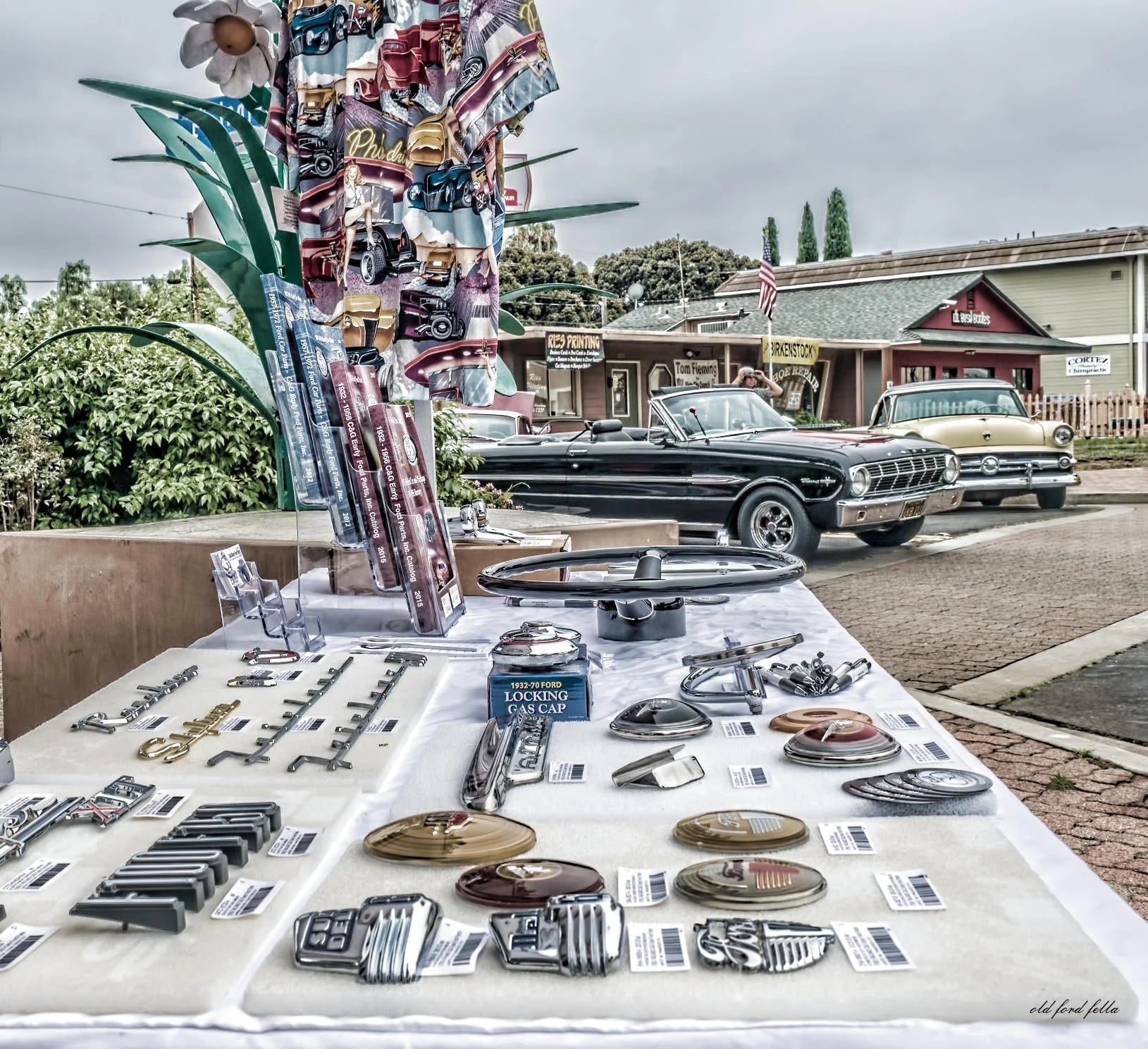
Classic Ford Parts for Classy Old Fords Seeing a vintage Ford gleaming in the sun at a local car show is a treat for the eyes, but even these beautiful vehicles need parts to keep them running smoothly. When something does go wrong with the vehicle, you need to find a store like ours – some place that understands the intricacies of troubleshooting and replacing old Ford parts and understands the mindset of the early Ford owner. You need to know that our selection covers 1932 through 1972 Old Ford cars and 1932 through 1979 old Ford trucks. We ship worldwide Monday through Friday. Unfortunately, you probably already personally experienced, and know all too well, what happens when you walk into a chain auto parts store looking for a part for a 1932 anything that Ford rolled off the assembly line. You’ll get a blank look for your asking. You might get lucky and the counter person will do a google search followed by a “no” if you’re lucky, or a shoulder shrug if you’re not. That’s because these shops carry more parts for current vehicles less than 10 years old and practically nothing for the Old Fords. So as a proof of concept; plug all the information about what you need for your vehicle into the online search area of a chain auto parts store, you’ll see no results and you’re back to square one. You can save yourself a lot of time and frustration by going straight to people like Kyle, Lee, Kristian or Joe – folks who know how important classic Ford parts are and exactly how to get those quality reproduction parts into your hands. People who own vintage Ford vehicles themselves. That’s one of the reasons we have over 200 vendors and tens of thousands of parts on the shelf, so that these vehicles get the right parts they need and will keep running long after other makes are sitting on the sidelines. When it comes to working on these old Ford vehicles, we have what you need, the folks who understand what you need and the "how it works", as well as the ability to get it to you fast anywhere in the world. Whether it’s a 1956 F100 truck and you need a windshield seal, or, a 1940 Ford car and it’s a tie rod, you’ll have to look no further than C&G Ford Parts. On the web or on the phone or even if you drop by and chew the fat at the parts counter, we know what classic Ford parts you need. So, forget the aftermarket big car parts chains and come experience good old fashioned customer service and quality know-how.
Evolution of Ford Generators

Evolution of Ford Generators

The evolution of the early Ford generator is a fascinating journey through the annals of automotive history, showcasing Ford's pioneering role in electrical system innovation. From the early 1900s to the 1950s, Ford generators underwent significant transformations in design and output, reflecting the increasing electrical demands of automobiles. 1920s: The Birth of the Ford Generator In the 1920s, Ford transitioned from the magneto system to actual generators. These early generators, used in models like the Model T, were a leap forward in automotive electrical systems. They typically produced about 6-8 volts and 10-15 amperes. This was a modest output, but it marked a significant improvement over the earlier systems, providing more reliable power for lighting and ignition. 1930s: Advancements in Power Output By the 1930s, as vehicles incorporated more electrical components, classic Ford generators evolved to meet these new demands. The output increased to approximately 12 volts, with the current rising to around 30-40 amperes. This improvement was crucial in powering additional features like radios and heaters, which were becoming standard in vehicles. 1940s: Post-War Technological Growth Post-World War II, the 1940s saw further advancements in Ford generators. The output stabilized around 12 volts, but the current capabilities expanded, reaching up to 40-50 amperes. This era's generators were more efficient and reliable, reflecting technological advancements and the growing complexity of automotive electrical systems. 1950s: The Peak of Generator Technology The 1950s represented the peak of generator technology before the transition to alternators. Ford generators during this decade were robust, producing 12 volts and capable of up to 50-60 amperes. This increased capacity was essential for powering more sophisticated electrical systems, including advanced lighting, climate control, and entertainment systems. In conclusion, the evolution of the early Ford generator from the 1920s to the 1950s is a testament to Ford's innovation in automotive technology. Each decade brought significant improvements in output and reliability, mirroring the evolution of automobiles themselves. From the humble beginnings of powering basic vehicle functions to meeting the demands of more complex and luxurious features, Ford generators played a crucial role in the advancement of automotive electrical systems.