FORD F100 HISTORY

FORD F100

FORD F100 HISTORY

In 1953, Ford launched a fresh era of F Series pickups. The 1953 pickups were officially called F-100 and featured sleeker designs with an all-new cab and front end design. This generation of F Series pickups had larger measurements that included 55% larger windshield glass due to its curved design. With the wider cab you can seat 3 full size adults. 1953 Ford also improved chassis now available in 110” and 118” wheelbase (1948-52 is 114”). The gas tank was moved from behind the seat and now mounted on the outside of the frame below the driver’s side of the cab. The upgrades were designed to foster toughness and driving performance. The F Series pickups also took on new names. The F-2 became the F-250. The F-3 was renamed the F-350. Options included a dome light, cigarette lighter, ashtray, sun visors, radio, recirculating air heater and hot water heater. The new name was retained by the F-100 until Ford discontinued production of the F-100 after the 1983 model-year. In 1954 the all-new 239 CID "Y" block engine became available. The 1956 F-100 was celebrated for its perpendicular windshield pillars and its wraparound windshield. Available on the Custom Cab model is a wraparound rear window. The “Y” block 272 was now available as was the 223 6 Cylinder. The gas tank was moved back into the cab behind the seat. Assembly of the F-100 in this time took place mostly in Dearborn, MI. Ford also made approximately 101,000 to 184,000 models of the F100 in Sao Paulo, Brazil.


SECOND GENERATION

The second generation of the Ford F-100 ran from 1957 through 1960. The important styling change for this generation was a lower hood sitting flush on top of the front fenders. Ford launched its tradition of providing two different pick up box styles in this generation. Separate rear fenders were featured on the traditional Stepside design. The new released Styleside layout featured smooth sides as well as a far more streamlined look. New for 1958 was the use of four headlights, Ford continued this until 1960. In 1959, Ford began making the F-100 with a unique four wheel drive. Ahead of this new development, outside makers such as American and Marmon-Herrington and Coleman occasionally converted normal Ford trucks to four wheel drive. The next generation of the vehicles also marked an increase in sales of the optional eight-foot bed for the F-100, the typical length of the bed was six and a half feet. The eight-foot bed eventually eclipsed its smaller counterpart in popularity among F-100 motorists. Assembly continued to take place in the Ford plant in Dearborn, MI.


THE 3RD GENERATION

The new pickups were lower to the ground and wider than earlier versions. 1961 F-100 offered the optional uni-body, which combined the cab and box into one body. Ford discontinued the unibody design at the end of the 1963 production after it fared dismally in the marketplace. 1961 and 1962 Ford still used one piece hood side emblems. In 1963 new body side trim was now available on the styleside trucks with a red painted stripe in the center of the trim. The all new hood side emblem now included a plastic insert with the size of the truck “100”, “250”, “350”. In 1965 designers lowered the cab floor enhancing interior room. 1965 Ford also launched the first of its all new front suspension the "Twin I-Beam". 1965 Also offers a 352 "FE" motor instead of the “Y” block 292. The 6 Cylinder engine is also upgraded from the 223 to the new 240. Ford offered the Ranger option in 1965. The designation referred to your field of options that included an interior optional bucket seats with console and carpeting instead of a rubber floor mat. Ford changed some of its own assembly in this time to a plant in Cuautitlan, Mexico.


FOURTH GENERATION

Ford engineers continued their emphasis on pickups in 1967 that offered a degree of comfort which was similar to a car. 1967 Has new unique hood side emblems. 1967 offered new exterior trim, the body side trim is also new 1-1/4” wide with thin black line top and bottom as well as, available rocker trim. With the new designed cab now includes a new cargo light for the bed at the back of the cab above the rear window. 1968 Changed the hood side emblem to include a reflector. Lower bed side reflectors are standard. The exterior trim is now wider at 1-1/2” wide with the black thin line top and bottom. The Ranger option now includes a grille emblem. New for 1968 is interior door lock knobs. The exterior trim is changed again for 1970. The grille is all new with a plastic inert for either side of the grille. The front of the hood now has a trim going from side to side. The bed side reflector is moved from the lower bed side to the end of the body side trim and now has a light in it. The new Ranger and Ranger XLT trim is now 3-5/8” wide. The new wide trim is available with either black for the Ranger option or woodgrain for the Ranger XLT. 1971 The steering wheel is changed to a two spoke wheel with optional black or woodgrain horn pad.


FIFTH GENERATION OF THE F100 AND INTRODUCTION OF THE F-150

The F-100 underwent major refinements for the fifth generation of the F Series, which ran from 1973 through 1979. Ford released the F-150, a fresh version, in 1973. The F-150 was essentially an F-100 with a spring package in the front and back that enabled the vehicle to carry a heavier load. Ford stopped production of the 4x4 F-100 in 1978. New grille with new plastic inserts for 1973 with the plastic insert now going around the headlight. The XLT option now included a grille emblem. The side trim was now available with a rubber insert down the center of the trim. The side reflectors now had light sockets with the front ones mounted in the front fenders and the rear still at the back of the bed trim. With the all new dash design trucks optioned with factory air conditioning now had vents in the dash for the air to go through and no longer was the air conditioning unit hanging from under the dash. 1974 Ford offered the new “Super Cab” with had a back bench seat and quarter windows behind the door. The new quarter windows were available fixed and with a pop out version. 1977 Offered a new exterior rim called “Race Trak” trim. The trim was a thin molding that started on the front fender at the grille and went down the side of the truck and curved up the bed side to meet the body side trim. Mid year 1978 Ford switch to square headlights which became standard for the F series trucks. Ford stopped producing the venerable F-100 entirely following the 1983 model year.

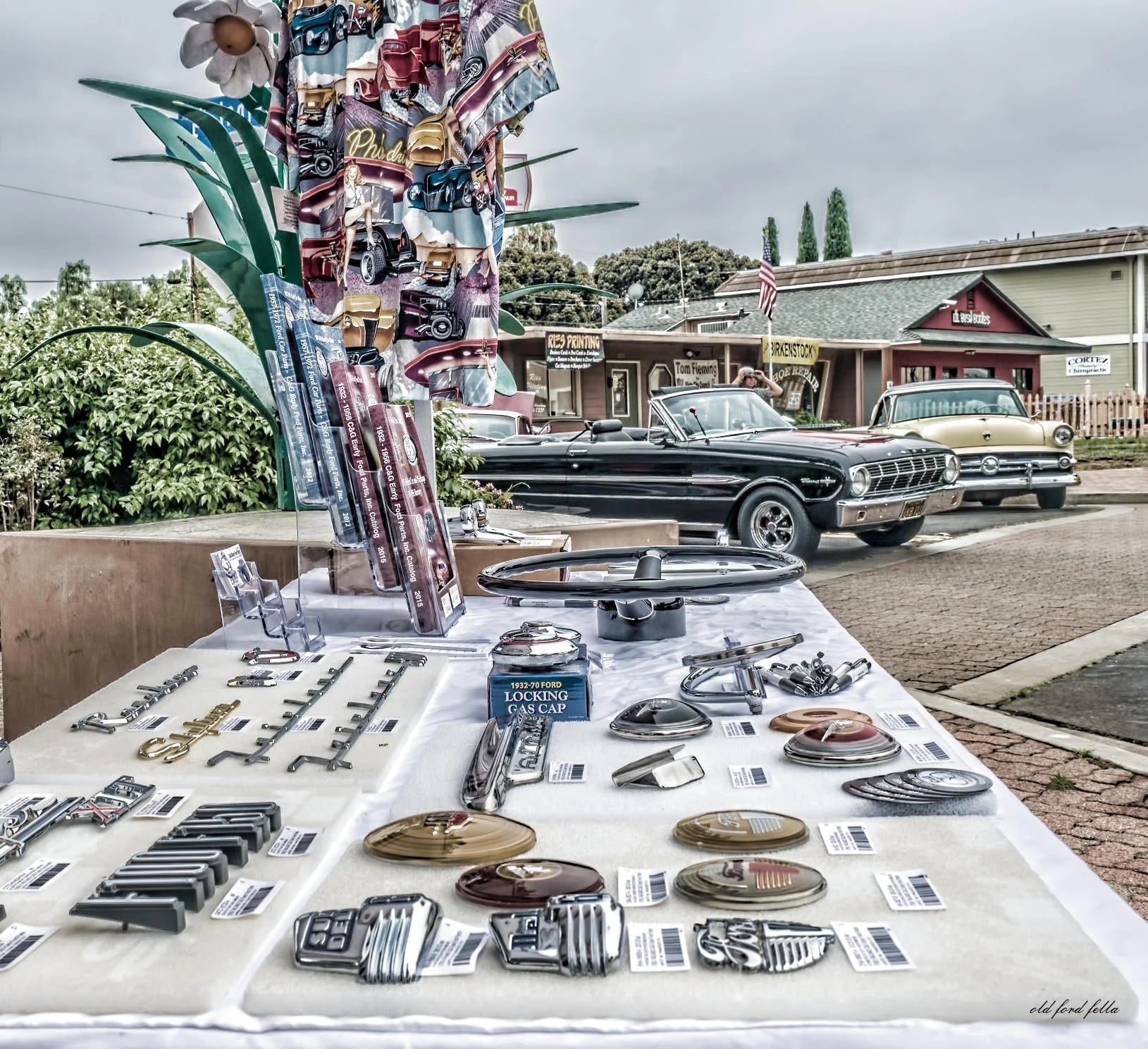
Fans of Ford F-100 pickups and Ford automobiles in general are motivated to see cgfordparts.com. The site is an excellent resource for locating thousands of old Ford parts now in reproduction. The expert staff members are prepared to answer questions and share their knowledge of Ford restoration.
Leave a comment

Please note, comments need to be approved before they are published.

MORE CLASSIC FORD INSIGHTS

No image

Ford F100 Parts

Owning or restoring a Ford F100 means that you’ll need easy access to Ford F100 parts whenever you need them. You want the right parts to keep your classic humming along for as long as you own it. If you’ve had your Ford for several years, then you probably already know where to get your hands on Ford F100 parts when you need them. If you don’t know because you haven’t had any issues with the truck until now, there are a lot of different ways you can find what you need. Check out places where other classic vehicle enthusiasts gather and talk to them. You can find groups that hang out on or offline. In some towns, the local drive-in restaurant has an area where classic car owners will gather on the weekends in order to show off their cars. The best place that you can buy Ford F100 parts is from an online store where the employees know about older model cars and trucks and can easily locate or order exactly what you need and ship it right to your doorstep. C&G Ford Parts fits that bill nicely. If you’ve already diagnosed the issue with your Ford and know exactly what part it is that you need, then getting it is going to be fairly simple. But, if like a lot of people, you don’t have in depth knowledge about what could be causing your truck’s issue, the pros can help if they specialize in classic car parts. Many of the employees in a classic auto part business have a love and admiration for the classics and they really know the older vehicles inside and out. Plus, by serving a lot of classic car owners when they have needs, this business more than likely has a lot experience with a wide range of vehicle problems. They may have heard all kinds of stories about what’s going on with the Ford truck and helped other owners with the right Ford F100 parts. Not only will the site know what you’re looking for, but a lot of times, if you ask them how to put a part on, they can tell you how or share online video tutorials with you and save you time. You gain the benefit of their parts knowledge as well as their mechanical knowledge for the same price. What they may suggest and you may find helpful, is to get a catalog of the parts that they do carry so that you’ll have a listing of the parts and the prices. For most classic vehicle owners, they want their F100 truck in pristine condition inside and out. Getting a part that’s “good enough” isn’t enough, they want the best Ford F100 parts.
No image

YOUR CLASSIC FORD PARTS STORE

YOUR CLASSIC FORD PARTS STORE If you own a classic Ford, you’re used to dependability. You go out, you start the vehicle, and it runs. That’s the way it should be. After all, when it’s an older Ford, it has longevity built right into it. Sometimes, though, things will take a toll on the best ride you’ve ever owned. Could be the weather - or a little ding or two that happens when someone isn’t paying attention and they run into you. Whatever the reason, if you’ve got something on your list that you need for your old Ford, you can find it at a C&G Ford Parts. You’ll find thousands upon thousands of parts that can get your Ford in the best shape, even if you own one from the late 1970's. That’s sure to give you peace of mind right there. Say you’ve got a 1979 Ford F150 pickup. The jet-black custom paint on it just glints in the sunlight. Your truck is the envy of the neighborhood and everywhere else that you take it. You worked hard for that truck and you deserve to show it off. Taking a friend out for a round or two of golf, you park the truck in the lot carefully away from other cars. But you know how it goes. There always has to be someone who parks right up on you. Only this time, they broke your driver’s side mirror up pretty good and took off without having the decency of letting anyone know. When you do a thorough examination, you see that the door is fine, but the mirror can’t be repaired - the damage is too bad. It’s got to be replaced. Besides making you mad, you’re now faced with the task of figuring out where you’re going to go to get one like it. No worries, because you can get the part you need right at a classic Ford parts store, C&G Ford Parts to be exact. Places that have the stock you’re looking for can easily cover getting you that mirror in no time. Best of all, getting that replacement mirror in an exact match for your truck isn’t going to cost you every penny you’ve got in the bank. At C&G Ford parts, not only will you find what you need when you need it, but you’ll find it for a reasonable price as well. You can’t always prevent bad drivers from doing foolish things and ending up damaging your Ford. But you can rest assured knowing that a C&G Ford parts has got you covered. So take that truck out for a spin any time. They’ll be waiting on you when you need them.
Reproduction parts vs used/nos

Reproduction parts vs used/nos

As a classic Ford enthusiast, my journey in the realm of restoration has been nothing short of exhausting. The thrill of bringing a vintage beauty back to its former glory is unparalleled. However, this passion comes with its challenges, the most significant being sourcing the right parts. This is where classic reproduction Ford parts have become a game-changer for someone like me. For years, the pursuit of authentic, original used and NOS parts was akin to searching for a needle in a haystack. These parts, often scarce and very expensive, could mean the difference between a stalled project and a triumphant restoration. Then entered the world of reproduction parts – a world that has not only made restoration more accessible but also more reliable. Initially, I was skeptical about using reproduction parts. Would they fit correctly? Would they maintain the authentic look and feel of my classic Ford? These concerns, however, were quickly dispelled. Modern reproduction parts are crafted so that they seamlessly blend with the original components. Manufacturers use advanced technologies and materials to replicate parts. One of the biggest advantages I've experienced with reproduction parts is the availability of parts. Unlike original parts, which may have undergone decades of wear and tear, reproduction parts are brand new and often incorporate modern engineering improvements. This doesn't just bring peace of mind; it enhances the driving experience, making it safer and more enjoyable. From a cost perspective, reproduction parts are generally more affordable than their NOS counterparts. This affordability has allowed me to allocate resources to other aspects of restoration, like professional paint jobs or interior refurbishments. Moreover, the availability of these parts means less time scouring swap meets and more time in the garage, doing what I love. In conclusion, classic reproduction Ford parts have transformed the restoration landscape for enthusiasts like me. They bridge the gap between the past and the present, ensuring that the legacy of classic Fords continues to cruise down our roads, not just reside in our memories. They are a testament to the evolving nature of car restoration, blending tradition with innovation, and keeping the spirit of classic Fords alive and roaring.