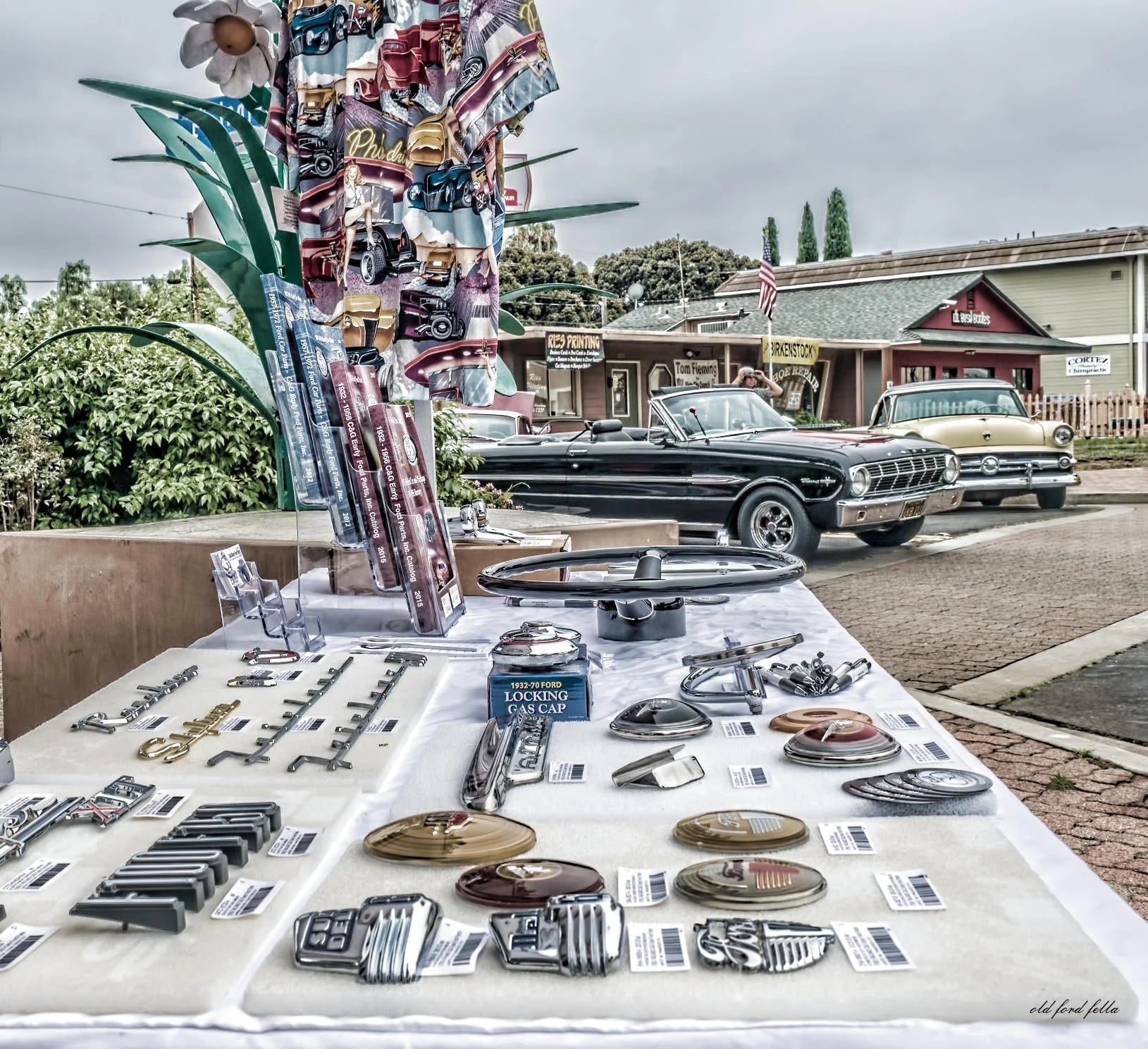
1950s Ford Cars and Trucks Evolution

1950s Ford Cars and Trucks Evolution

The 1950s marked a period of significant evolution for Ford Motor Company in both the automotive and truck sectors, characterized by engineering innovations and aggressive marketing strategies that aimed to capture the burgeoning post-war American market.

Engineering Innovations:

Starting with the 1949 models, Ford introduced a complete redesign that set the tone for the decade. This new line was characterized by more aerodynamic and modern styling, moving away from the pre-war designs. The Ford '49, as it was popularly known, featured a more integrated body design with smooth lines, which was a significant departure from the previous look. This design ethos continued into the 1950s, with each model year bringing incremental changes, but the 1952, 1955, and 1957 models were particularly notable for their styling advancements and engineering enhancements.

The introduction of the overhead valve (OHV) V-8 engine in 1954 was a pivotal engineering achievement, leading to the launch of vehicles like the Thunderbird in 1955, which was Ford's answer to Chevrolet's Corvette. This engine was not only more powerful with its 181 horsepower but also set Ford apart in what became known as the horsepower race of the 1950s. The Fairlane Crown Victoria, introduced later in 1955, embodied luxury within the mid-price range, featuring this new V-8 engine alongside other engineering improvements like power steering and brakes, which became options in Ford's vehicles during this period.

For trucks, the 1950s saw the further development of the F-Series, which had been introduced in 1948. The F-Series trucks evolved with the inclusion of a more robust chassis, new suspension systems, and eventually, the integration of V-8 engines, making them not only workhorses but also suitable for personal use. The F-100, in particular, became a cultural icon, known for its sleek design and versatility.

Marketing Strategies:

Ford's marketing in the 1950s was as dynamic as its engineering. The company leveraged the post-war economic boom, focusing on the American dream of owning a car. Ford capitalized on the new consumer culture by introducing vehicles that appealed to a wide demographic. The Thunderbird, for instance, was marketed not as a sports car but as a "personal car," emphasizing comfort and style over raw performance, aiming to attract both men and women.

The introduction of models like the Edsel in 1958 was an ambitious marketing move. Named after Henry Ford's son, it was meant to fill the gap between Ford and Mercury in Ford's product lineup. Despite its innovative features like push-button transmission controls and a unique grille design, the Edsel was a commercial failure due to poor market reception, which highlighted the limits of marketing when not backed by consumer desire.

Ford also pioneered safety features, introducing seat belts as standard in 1956, a move that was heavily marketed as part of Ford's commitment to customer safety. This era also saw Ford's advertising becoming more sophisticated, using television and print media to showcase their vehicles' modernity, performance, and styling.

In summary, the 1950s were transformative for Ford. From engineering perspectives, the decade was about power, efficiency, and safety, while from a marketing standpoint, it was about capturing the spirit of an era filled with optimism and economic prosperity. Ford's vehicles during this decade not only shaped its destiny but also influenced the American automotive landscape profoundly.

Leave a comment

Please note, comments need to be approved before they are published.

MORE CLASSIC FORD INSIGHTS

1964 FORD FALCON SPRINT

1964 Ford Falcon Sprint a Brief History

1964 Ford Falcon Sprint The 1964 Ford Falcon Sprint is a classic Ford car that holds a special place in the hearts of many car enthusiasts. This vintage Ford model was known for its sleek design, powerful engine, and affordable price. While it may have been over 50 years since its release, the 1964 Ford Falcon Sprint is still a highly sought-after car for collectors and enthusiasts alike. In this article, we will explore the history of this iconic car and discuss the process of restoring one to its former glory. The History of the 1964 Ford Falcon Sprint 1964 Ford Falcon Sprint The Ford Falcon was first introduced in 1960 as a compact car designed to compete with other popular models of the time, such as the Chevrolet Corvair and the Plymouth Valiant. In 1963, Ford released the Falcon Sprint in hardtop and convertible, a sportier version of the original Falcon. The Sprint featured a more powerful 260 cid V8 engine, bucket seats, and a floor-mounted shifter (when equipped with the optional 4 speed), making it a popular choice among car enthusiasts. The Falcon Sprint hardtop was also used in various racing events, solidifying its reputation as a high-performance vehicle. If you're looking to restore a 1964 Ford Falcon Sprint, the first step is to find one for sale. While it may be challenging to find one in good condition, there are still some available for purchase. You can search online for classic car dealerships or browse through online marketplaces such as eBay or Craigslist. It's essential to thoroughly inspect the car before making a purchase, as it may require significant restoration work. Restoring a vintage car like the 1964 Ford Falcon Sprint requires a lot of time, effort, and money. It's crucial to have a clear plan and budget in place before starting the restoration process. The first step is to assess the condition of the car and determine which parts need to be replaced or repaired. It's essential to use original or high-quality reproduction Ford parts to maintain the authenticity and value of the car. Once you have successfully restored your 1964 Ford Falcon Sprint, it's crucial to maintain it properly to preserve its value and performance. Regular maintenance, such as oil changes, tune-ups, and inspections, is essential to keep the car running smoothly. It's also essential to store the car in a dry, climate-controlled environment to prevent rust and other damage. Owning a 1964 Ford Falcon Sprint is more than just having a classic car; it's about reviving nostalgia and preserving a piece of history. Restoring this iconic car is a labor of love that requires dedication and passion. But the end result is a beautiful, high-performance vehicle that will turn heads and bring joy to its owner. Are you a fan of the 1964 Ford Falcon Sprint? Have you restored one yourself? Share your thoughts and experiences in the comments below.
Tracing back the gears of time, the story of Ford's iconic

Tracing back the gears of time, the story of Ford's iconic "P-R-N-D-L"

Tracing back the gears of time, the story of Ford's iconic "P-R-N-D-L" (affectionately pronounced "prindle") starts in the golden era of automotive innovation. This simple, yet memorable acronym represents the sequence of gears on an automatic transmission: Park, Reverse, Neutral, Drive, and Low. It's a nostalgic nod to the heyday of American car culture, beginning its journey in the 1950s. In 1951, Ford revolutionized their lineup by introducing the first "automatic" transmission in its cars. This was the birth of the P-R-N-D-L sequence, a groundbreaking innovation at the time. Imagine the delight of drivers who, for the first time, could shift gears with a smooth slide of the lever, just once – a far cry from the manual efforts of the past. It should also be noted that unlike todays automatics the early automatics would only start in neutral! The 1950s and 60s were a golden age for Ford. Cars were more than mere transport; they symbolized freedom, style, and the American dream. The P-R-N-D-L was an integral part of this. It wasn't just about the ease of shifting gears; it was about the experience. Each letter was a step in the ritual of driving, a connection between human and machine that modern digital interfaces can't replicate. Fast forward to today, and while cars have evolved with dizzying technology and efficiency, the charm of the classic Ford P-R-N-D-L endures. For enthusiasts and collectors, operating this gearshift isn't just a mechanical action; it's a trip down memory lane, a tactile piece of history that harkens back to the days of chrome, tailfins, and the open road. In essence, the P-R-N-D-L of classic Ford cars is more than just a gear sequence. It's a symbol of a bygone era, a testament to Ford's pioneering spirit, and an enduring part of America's automotive legacy.
No image

Reviving Nostalgia: Overview of the 1964 Ford Falcon Sprint

The 1964 Ford Falcon Sprint is a classic car that holds a special place in the hearts of many car enthusiasts. This vintage Ford model was known for its sleek design, powerful engine, and affordable price. While it may have been over 50 years since its release, the 1964 Ford Falcon Sprint is still a highly sought-after car for collectors and enthusiasts alike. In this article, we will explore the history of this iconic car and discuss the process of restoring one to its former glory. The History of the 1964 Ford Falcon Sprint 1964 Ford Falcon Sprint The Ford Falcon was first introduced in 1960 as a compact car designed to compete with other popular models of the time, such as the Chevrolet Corvair and the Plymouth Valiant. In 1963, Ford released the Falcon Sprint in hardtop and convertible, a sportier version of the original Falcon. The Sprint featured a 260 cid V8 engine, bucket seats, and a floor-mounted shifter (when equipped with the optional 4 speed), making it a popular choice among car enthusiasts. The Falcon Sprint hardtop was also used in various racing events, solidifying its reputation as a high-performance vehicle. If you're looking to restore a 1964 Ford Falcon Sprint, the first step is to find one for sale. While it may be challenging to find one in good condition, there are still some available for purchase. You can search online for classic car dealerships or browse through online marketplaces such as eBay or Craigslist. It's essential to thoroughly inspect the car before making a purchase, as it may require significant restoration work. Restoring a vintage car like the 1964 Ford Falcon Sprint requires a lot of time, effort, and money. It's crucial to have a clear plan and budget in place before starting the restoration process. The first step is to assess the condition of the car and determine which parts need to be replaced or repaired. It's essential to use original or high-quality reproduction parts to maintain the authenticity and value of the car. Once you have successfully restored your 1964 Ford Falcon Sprint, it's crucial to maintain it properly to preserve its value and performance. Regular maintenance, such as oil changes, tune-ups, and inspections, is essential to keep the car running smoothly. It's also essential to store the car in a dry, climate-controlled environment to prevent rust and other damage. Owning a 1964 Ford Falcon Sprint is more than just having a classic car; it's about reviving nostalgia and preserving a piece of history. Restoring this iconic car is a labor of love that requires dedication and passion. But the end result is a beautiful, high-performance vehicle that will turn heads and bring joy to its owner. Are you a fan of the 1964 Ford Falcon Sprint? Have you restored one yourself? Share your thoughts and experiences in the comments below.