Exploring an American Classic The Ford F100

Ford F100

The Ford F100, a member of the renowned F-Series, has a rich history that spans decades, evolving from a utilitarian work truck to a sought-after classic. Originally designed to meet the demands of post-war America, the F-100 has since become a symbol of vintage style and automotive nostalgia.

The F-100 debuted in 1953, a milestone that marked the second generation of Ford's F-Series. Known for its increased dimensions, improved engines, and updated aesthetics, the F-100 was a significant upgrade from its predecessors. It featured a more powerful 215cid inline-six engine, with an option for a 239cid V8, delivering robust performance for the era. The truck boasted a maximum payload capacity of approximately 1,000 to 1,500 pounds, catering to the needs of businesses and individual users alike.

In terms of pricing, the F-100 was marketed as an affordable, reliable work truck. Prices started around $1,600, a figure that, when adjusted for inflation, underscores the truck's value proposition. Fast forward to the present, and the Ford F100 occupies a different space in the automotive world. No longer just a work vehicle, it has become a beloved classic, cherished by collectors and enthusiasts.

The market for vintage F-100s has seen a significant uptick, with fully restored models fetching prices upwards of $20,000 to $30,000, and exceptional specimens or custom builds going even higher. The appeal of the F-100 in today's market lies in its simplicity, classic design, and the nostalgia it evokes. It's a canvas for customization, with a thriving aftermarket offering everything from original replacement parts to modern upgrades.

The versatility of the F-100 makes it a favorite among those looking to create a personalized classic that combines vintage charm with modern performance. The demand for original equipment specifications remains high, with purists seeking to restore F-100s to their factory glory. This desire for authenticity reflects a broader trend in the classic car market, where originality often equates to higher value.

Conclusion

The Ford F-100's journey from a practical utility vehicle to a cherished classic is a testament to its enduring appeal. In the current market, it embodies a blend of history, style, and the enduring legacy of Ford's commitment to utility and innovation. Whether restored to its original specifications or customized to modern tastes, the F-100 remains a beloved piece of American automotive history, with a vibrant community of enthusiasts keeping its spirit alive.

Leave a comment

Please note, comments need to be approved before they are published.

MORE CLASSIC FORD INSIGHTS

FORD F100

FORD F100 HISTORY

FORD F100 HISTORY In 1953, Ford launched a fresh era of F Series pickups. The 1953 pickups were officially called F-100 and featured sleeker designs with an all-new cab and front end design. This generation of F Series pickups had larger measurements that included 55% larger windshield glass due to its curved design. With the wider cab you can seat 3 full size adults. 1953 Ford also improved chassis now available in 110” and 118” wheelbase (1948-52 is 114”). The gas tank was moved from behind the seat and now mounted on the outside of the frame below the driver’s side of the cab. The upgrades were designed to foster toughness and driving performance. The F Series pickups also took on new names. The F-2 became the F-250. The F-3 was renamed the F-350. Options included a dome light, cigarette lighter, ashtray, sun visors, radio, recirculating air heater and hot water heater. The new name was retained by the F-100 until Ford discontinued production of the F-100 after the 1983 model-year. In 1954 the all-new 239 CID "Y" block engine became available. The 1956 F-100 was celebrated for its perpendicular windshield pillars and its wraparound windshield. Available on the Custom Cab model is a wraparound rear window. The “Y” block 272 was now available as was the 223 6 Cylinder. The gas tank was moved back into the cab behind the seat. Assembly of the F-100 in this time took place mostly in Dearborn, MI. Ford also made approximately 101,000 to 184,000 models of the F100 in Sao Paulo, Brazil. SECOND GENERATION The second generation of the Ford F-100 ran from 1957 through 1960. The important styling change for this generation was a lower hood sitting flush on top of the front fenders. Ford launched its tradition of providing two different pick up box styles in this generation. Separate rear fenders were featured on the traditional Stepside design. The new released Styleside layout featured smooth sides as well as a far more streamlined look. New for 1958 was the use of four headlights, Ford continued this until 1960. In 1959, Ford began making the F-100 with a unique four wheel drive. Ahead of this new development, outside makers such as American and Marmon-Herrington and Coleman occasionally converted normal Ford trucks to four wheel drive. The next generation of the vehicles also marked an increase in sales of the optional eight-foot bed for the F-100, the typical length of the bed was six and a half feet. The eight-foot bed eventually eclipsed its smaller counterpart in popularity among F-100 motorists. Assembly continued to take place in the Ford plant in Dearborn, MI. THE 3RD GENERATION The new pickups were lower to the ground and wider than earlier versions. 1961 F-100 offered the optional uni-body, which combined the cab and box into one body. Ford discontinued the unibody design at the end of the 1963 production after it fared dismally in the marketplace. 1961 and 1962 Ford still used one piece hood side emblems. In 1963 new body side trim was now available on the styleside trucks with a red painted stripe in the center of the trim. The all new hood side emblem now included a plastic insert with the size of the truck “100”, “250”, “350”. In 1965 designers lowered the cab floor enhancing interior room. 1965 Ford also launched the first of its all new front suspension the "Twin I-Beam". 1965 Also offers a 352 "FE" motor instead of the “Y” block 292. The 6 Cylinder engine is also upgraded from the 223 to the new 240. Ford offered the Ranger option in 1965. The designation referred to your field of options that included an interior optional bucket seats with console and carpeting instead of a rubber floor mat. Ford changed some of its own assembly in this time to a plant in Cuautitlan, Mexico. FOURTH GENERATION Ford engineers continued their emphasis on pickups in 1967 that offered a degree of comfort which was similar to a car. 1967 Has new unique hood side emblems. 1967 offered new exterior trim, the body side trim is also new 1-1/4” wide with thin black line top and bottom as well as, available rocker trim. With the new designed cab now includes a new cargo light for the bed at the back of the cab above the rear window. 1968 Changed the hood side emblem to include a reflector. Lower bed side reflectors are standard. The exterior trim is now wider at 1-1/2” wide with the black thin line top and bottom. The Ranger option now includes a grille emblem. New for 1968 is interior door lock knobs. The exterior trim is changed again for 1970. The grille is all new with a plastic inert for either side of the grille. The front of the hood now has a trim going from side to side. The bed side reflector is moved from the lower bed side to the end of the body side trim and now has a light in it. The new Ranger and Ranger XLT trim is now 3-5/8” wide. The new wide trim is available with either black for the Ranger option or woodgrain for the Ranger XLT. 1971 The steering wheel is changed to a two spoke wheel with optional black or woodgrain horn pad. FIFTH GENERATION OF THE F100 AND INTRODUCTION OF THE F-150 The F-100 underwent major refinements for the fifth generation of the F Series, which ran from 1973 through 1979. Ford released the F-150, a fresh version, in 1973. The F-150 was essentially an F-100 with a spring package in the front and back that enabled the vehicle to carry a heavier load. Ford stopped production of the 4x4 F-100 in 1978. New grille with new plastic inserts for 1973 with the plastic insert now going around the headlight. The XLT option now included a grille emblem. The side trim was now available with a rubber insert down the center of the trim. The side reflectors now had light sockets with the front ones mounted in the front fenders and the rear still at the back of the bed trim. With the all new dash design trucks optioned with factory air conditioning now had vents in the dash for the air to go through and no longer was the air conditioning unit hanging from under the dash. 1974 Ford offered the new “Super Cab” with had a back bench seat and quarter windows behind the door. The new quarter windows were available fixed and with a pop out version. 1977 Offered a new exterior rim called “Race Trak” trim. The trim was a thin molding that started on the front fender at the grille and went down the side of the truck and curved up the bed side to meet the body side trim. Mid year 1978 Ford switch to square headlights which became standard for the F series trucks. Ford stopped producing the venerable F-100 entirely following the 1983 model year. Fans of Ford F-100 pickups and Ford automobiles in general are motivated to see cgfordparts.com. The site is an excellent resource for locating thousands of old Ford parts now in reproduction. The expert staff members are prepared to answer questions and share their knowledge of Ford restoration.
No image

Ford F100 Parts

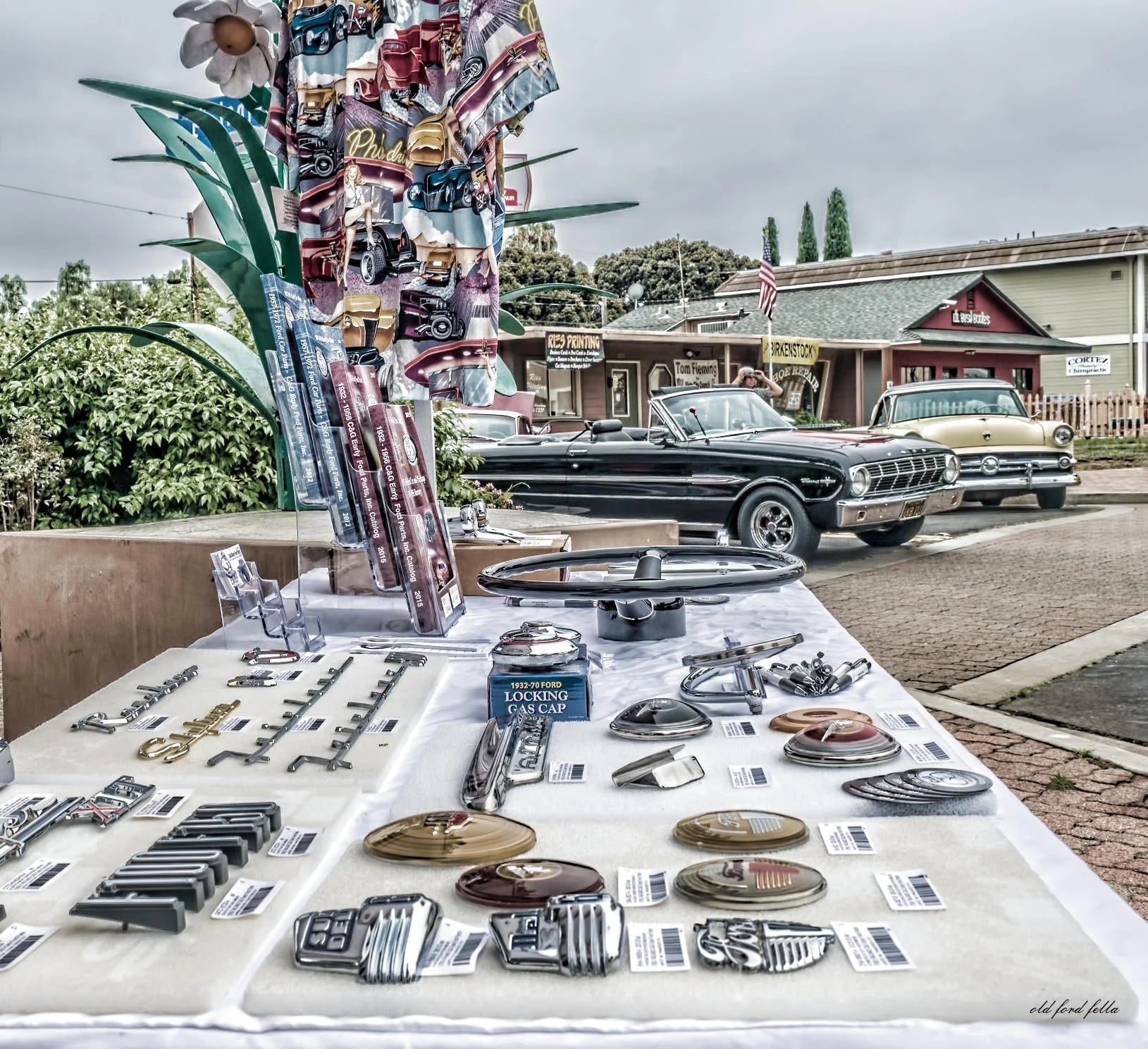
Owning or restoring a Ford F100 means that you’ll need easy access to Ford F100 parts whenever you need them. You want the right parts to keep your classic humming along for as long as you own it. If you’ve had your Ford for several years, then you probably already know where to get your hands on Ford F100 parts when you need them. If you don’t know because you haven’t had any issues with the truck until now, there are a lot of different ways you can find what you need. Check out places where other classic vehicle enthusiasts gather and talk to them. You can find groups that hang out on or offline. In some towns, the local drive-in restaurant has an area where classic car owners will gather on the weekends in order to show off their cars. The best place that you can buy Ford F100 parts is from an online store where the employees know about older model cars and trucks and can easily locate or order exactly what you need and ship it right to your doorstep. C&G Ford Parts fits that bill nicely. If you’ve already diagnosed the issue with your Ford and know exactly what part it is that you need, then getting it is going to be fairly simple. But, if like a lot of people, you don’t have in depth knowledge about what could be causing your truck’s issue, the pros can help if they specialize in classic car parts. Many of the employees in a classic auto part business have a love and admiration for the classics and they really know the older vehicles inside and out. Plus, by serving a lot of classic car owners when they have needs, this business more than likely has a lot experience with a wide range of vehicle problems. They may have heard all kinds of stories about what’s going on with the Ford truck and helped other owners with the right Ford F100 parts. Not only will the site know what you’re looking for, but a lot of times, if you ask them how to put a part on, they can tell you how or share online video tutorials with you and save you time. You gain the benefit of their parts knowledge as well as their mechanical knowledge for the same price. What they may suggest and you may find helpful, is to get a catalog of the parts that they do carry so that you’ll have a listing of the parts and the prices. For most classic vehicle owners, they want their F100 truck in pristine condition inside and out. Getting a part that’s “good enough” isn’t enough, they want the best Ford F100 parts.
1964 FORD FALCON SPRINT

1964 Ford Falcon Sprint a Brief History

1964 Ford Falcon Sprint The 1964 Ford Falcon Sprint is a classic Ford car that holds a special place in the hearts of many car enthusiasts. This vintage Ford model was known for its sleek design, powerful engine, and affordable price. While it may have been over 50 years since its release, the 1964 Ford Falcon Sprint is still a highly sought-after car for collectors and enthusiasts alike. In this article, we will explore the history of this iconic car and discuss the process of restoring one to its former glory. The History of the 1964 Ford Falcon Sprint 1964 Ford Falcon Sprint The Ford Falcon was first introduced in 1960 as a compact car designed to compete with other popular models of the time, such as the Chevrolet Corvair and the Plymouth Valiant. In 1963, Ford released the Falcon Sprint in hardtop and convertible, a sportier version of the original Falcon. The Sprint featured a more powerful 260 cid V8 engine, bucket seats, and a floor-mounted shifter (when equipped with the optional 4 speed), making it a popular choice among car enthusiasts. The Falcon Sprint hardtop was also used in various racing events, solidifying its reputation as a high-performance vehicle. If you're looking to restore a 1964 Ford Falcon Sprint, the first step is to find one for sale. While it may be challenging to find one in good condition, there are still some available for purchase. You can search online for classic car dealerships or browse through online marketplaces such as eBay or Craigslist. It's essential to thoroughly inspect the car before making a purchase, as it may require significant restoration work. Restoring a vintage car like the 1964 Ford Falcon Sprint requires a lot of time, effort, and money. It's crucial to have a clear plan and budget in place before starting the restoration process. The first step is to assess the condition of the car and determine which parts need to be replaced or repaired. It's essential to use original or high-quality reproduction Ford parts to maintain the authenticity and value of the car. Once you have successfully restored your 1964 Ford Falcon Sprint, it's crucial to maintain it properly to preserve its value and performance. Regular maintenance, such as oil changes, tune-ups, and inspections, is essential to keep the car running smoothly. It's also essential to store the car in a dry, climate-controlled environment to prevent rust and other damage. Owning a 1964 Ford Falcon Sprint is more than just having a classic car; it's about reviving nostalgia and preserving a piece of history. Restoring this iconic car is a labor of love that requires dedication and passion. But the end result is a beautiful, high-performance vehicle that will turn heads and bring joy to its owner. Are you a fan of the 1964 Ford Falcon Sprint? Have you restored one yourself? Share your thoughts and experiences in the comments below.