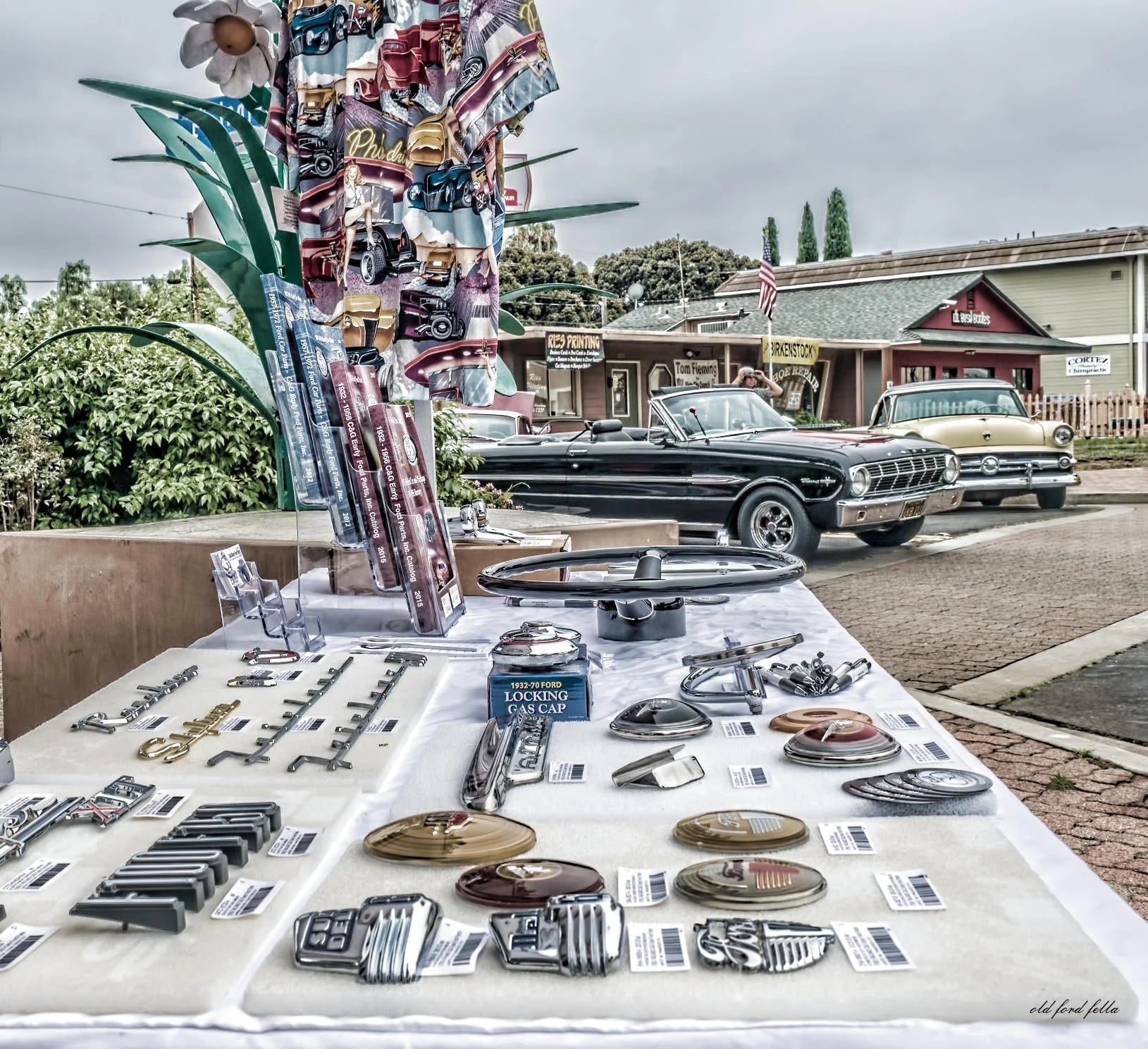
1950s Ford Cars and Trucks Evolution

1950s Ford Cars and Trucks Evolution

The 1950s marked a period of significant evolution for Ford Motor Company in both the automotive and truck sectors, characterized by engineering innovations and aggressive marketing strategies that aimed to capture the burgeoning post-war American market.

Engineering Innovations:

Starting with the 1949 models, Ford introduced a complete redesign that set the tone for the decade. This new line was characterized by more aerodynamic and modern styling, moving away from the pre-war designs. The Ford '49, as it was popularly known, featured a more integrated body design with smooth lines, which was a significant departure from the previous look. This design ethos continued into the 1950s, with each model year bringing incremental changes, but the 1952, 1955, and 1957 models were particularly notable for their styling advancements and engineering enhancements.

The introduction of the overhead valve (OHV) V-8 engine in 1954 was a pivotal engineering achievement, leading to the launch of vehicles like the Thunderbird in 1955, which was Ford's answer to Chevrolet's Corvette. This engine was not only more powerful with its 181 horsepower but also set Ford apart in what became known as the horsepower race of the 1950s. The Fairlane Crown Victoria, introduced later in 1955, embodied luxury within the mid-price range, featuring this new V-8 engine alongside other engineering improvements like power steering and brakes, which became options in Ford's vehicles during this period.

For trucks, the 1950s saw the further development of the F-Series, which had been introduced in 1948. The F-Series trucks evolved with the inclusion of a more robust chassis, new suspension systems, and eventually, the integration of V-8 engines, making them not only workhorses but also suitable for personal use. The F-100, in particular, became a cultural icon, known for its sleek design and versatility.

Marketing Strategies:

Ford's marketing in the 1950s was as dynamic as its engineering. The company leveraged the post-war economic boom, focusing on the American dream of owning a car. Ford capitalized on the new consumer culture by introducing vehicles that appealed to a wide demographic. The Thunderbird, for instance, was marketed not as a sports car but as a "personal car," emphasizing comfort and style over raw performance, aiming to attract both men and women.

The introduction of models like the Edsel in 1958 was an ambitious marketing move. Named after Henry Ford's son, it was meant to fill the gap between Ford and Mercury in Ford's product lineup. Despite its innovative features like push-button transmission controls and a unique grille design, the Edsel was a commercial failure due to poor market reception, which highlighted the limits of marketing when not backed by consumer desire.

Ford also pioneered safety features, introducing seat belts as standard in 1956, a move that was heavily marketed as part of Ford's commitment to customer safety. This era also saw Ford's advertising becoming more sophisticated, using television and print media to showcase their vehicles' modernity, performance, and styling.

In summary, the 1950s were transformative for Ford. From engineering perspectives, the decade was about power, efficiency, and safety, while from a marketing standpoint, it was about capturing the spirit of an era filled with optimism and economic prosperity. Ford's vehicles during this decade not only shaped its destiny but also influenced the American automotive landscape profoundly.

Leave a comment

Please note, comments need to be approved before they are published.

MORE CLASSIC FORD INSIGHTS

The 1955 Ford Fairlane: A Classic Icon of American Automotive History

The 1955 Ford Fairlane: A Classic Icon of American Automotive History

The 1955 Ford Fairlane: A Classic Icon of American Automotive History In the realm of classic American automobiles, the 1955 Ford Fairlane stands out as a significant model that marked Ford's return to prominence in the auto market. Named after Henry Ford's estate, Fair Lane, in Dearborn, Michigan, the Fairlane was introduced as Ford's premier car for that year. With a new frame and 11" brakes, the Fairlane replaced the Crestline as the flagship offering. Design and Styling The 1955 Fairlane was distinguished by its elegant and modern styling, characterized by a lower, longer, and wider profile compared to its predecessors. It featured a distinctive stainless steel stripe running along its side with striking 2 tone paint schemes, which became a hallmark of the Fairlane models. The car was offered in six different body styles, including two- and four-door sedans, hardtop, and a convertible known as the Sunliner. A standout among these was the Crown Victoria, which boasted a tinted, transparent roof panel, adding a futuristic touch to its design. Engine and Performance The Fairlane came equipped with options for both a 223 cubic inch (3.7 L) straight-six engine, a 272 cubic inch (4.5 L) V8, or a 292 cubic inch V8 (4.8 L) with a 4 barrel carb providing buyers with choices tailored to different performance needs. The V8, in particular, was a point of interest for its power and smooth operation. Transmission options included a Fordomatic automatic or a three-speed manual. Market Impact The introduction of the Fairlane was part of a broader effort by Ford to rejuvenate its lineup and recapture market share from competitors like Chevrolet. The Fairlane was not just a vehicle; it was a statement of Ford's commitment to innovation and style. In 1955, Ford managed to outsell Chevrolet, ending a 20-year streak where Chevy had been the best-selling car in America, a testament to the Fairlane's appeal and Ford's strategic marketing. Features and Accessories Ford emphasized luxury and convenience with the Fairlane. It included features like dual exhaust systems on higher-end models which improved both performance and sound. The car also introduced several firsts, including Ford's first factory-installed air conditioning system, known as "Select Aire," which was optional. Innovations like the panoramic windshields, new for 1955, offered drivers a broader view, enhancing safety and driving experience. Cultural Impact The 1955 Fairlane wasn't just a car; it became an emblem of the era's optimism and love for automotive style. Its design and engineering influenced subsequent Ford models and left a lasting impression on American car culture. The Fairlane's success helped pave the way for future models, including the introduction of the Fairlane 500. Legacy Today, the 1955 Ford Fairlane is celebrated by collectors and car enlthusiasts for its blend of style, performance, and historical significance. Restorations are common, and the car's parts are sought after, with companies like Classic Industries providing a range of reproduction parts for enthusiasts looking to bring their Fairlane back to its original splendor. In conclusion, the 1955 Ford Fairlane was more than just another car on the road; it was a symbol of Ford's resurgence and a reflection of the vibrant automotive culture of the 1950s. Its design, performance, and the enduring legacy it left behind continue to make it a beloved piece of automotive history.
Baby Moon hub cap

Baby Moon hub cap

The Baby Moon Hub Cap: A Blast from the Past If you're a fan of classic automobiles and have a soft spot for Americana, you've likely come across the term "baby moon hub cap" at some point. These shiny, timeless accessories have a fascinating history and a unique place in the world of automotive design. In this blog post, we'll dive into the development, design, production statistics, and popularity of the baby moon hub cap. Development and Design The Baby Moon hub cap, also known simply as "baby moons," emerged during the golden era of classic Ford automobiles in the 1950s and 1960s. These hub caps are characterized by their smooth, minimalist design. Unlike their full-sized counterparts, which were aluminium, baby moons were all about simplicity and elegance. Made from high-quality chrome or stainless steel, baby moons were designed to fit snugly over the hub of a car's wheel, providing a clean and polished look. Their minimalist design made them a popular choice among car enthusiasts who appreciated the understated beauty of classic cars. Production Statistics While it's challenging to pinpoint exact production statistics for baby moon hub caps, they were widely produced during the mid-20th century, primarily as aftermarket accessories. Various manufacturers, including companies like Mooneyes, produced these hub caps to cater to the growing demand from car owners looking to enhance the aesthetics of their vehicles. During their heyday, baby moons could be found on a wide range of American cars, including Ford, Chevrolet, and Dodge models. They became a symbol of the era's automotive style and are closely associated with the classic Ford automobiles that many enthusiasts still cherish today. Popularity Over the Years The popularity of baby moon hub caps has endured over the years, thanks to their timeless design and association with the classic Americana era. Car enthusiasts and collectors continue to seek out these hub caps to complete the authentic look of their vintage vehicles. Additionally, baby moons have found a place in modern hot rod and custom car culture. Enthusiasts often use them to add a touch of nostalgia to their custom builds, demonstrating the enduring appeal of these simple yet iconic accessories. Conclusion In conclusion, the baby moon hub cap is a classic automotive accessory that has left an indelible mark on the world of classic cars and Americana. Its development, design, and continued popularity reflect the enduring appeal of timeless automotive aesthetics. While exact production statistics may be elusive, the legacy of the baby moon hub cap lives on in the hearts of car enthusiasts and collectors, making it a cherished piece of automotive history.
No image

Old Ford? Come experience GREAT customer service!

Old Ford? Come experience GREAT customer service! Have you had enough of poor customer service and lack of technical knowledge when it comes to your old Ford? Believe me we know what it's like. If you're like most people, you probably start off full of drive and excitement, and making good progress on your project for a few weeks or months, but then - Murphy gets busy annoying you! As soon as you get one thing sorted another pops up, you get distracted and your project gets dumped in the too hard basket. And to make matters worse, there's always that one person who keeps asking you how your restoration is going, and you know they're having a good old laugh at your expense. You end up feeling confused and overwhelmed by all the technical jargon and mechanical issues you just don't understand. Until recently the only solution for amateur mechanics trying to break through the restoration problem on an old Ford, was to either obtain a full-time flathead mechanic somewhere or to hire a restoration company to do it for you. The problem with this option is that expert flathead mechanics are hard to find, and even if you do manage to find one willing to help you out, you'll be looking at upwards of $100 per hour, which is simply out of reach for most old ford owners. And it's for this reason that I'm pleased to reveal C&G Ford Parts has free technical help for its customers and we are staffed with folks that currently own or have owned old Ford cars or old Ford trucks! Here at C&G Ford Parts we've been helping old Ford owners with their restoration needs and supplies for over 40 years! And what we've proven over and over in our business is that the easiest and most reliable way to finish up your project is by adding a go to guy to your toolbox. It's literally the difference between a frustrating and annoying project and a "life changing, quit your job" kind of result. (ok, maybe not quit your job). With C&G Ford Parts lending their expertise and supplying your parts you'll be able to restore your vehicle with the fun and excitement you had hoped it would bring! If you get stuck you always know all you need to do is dial us up or drop us an email and we'll be there! Now what makes our service different from any other parts service out there is that there's NO additional costs - No out today fees, no added shipping fees, no waiting for days for a tech to call back AND you're covered for as long as you're a customer! Let's take a look at how C&G Ford Parts helps you. Our customers enjoy: Free tech support from old ford owners Friendly live person customer service Best reproduction parts available Over 100 manufacturers Worldwide shipping This is just a taste of what people are already saying about C&G Ford Parts: ----- Well organized, responsive, helpful in planning parts needs for specific project —Lawrence G. ----- How quick and efficient can you guys get?!! —Terry M. So, You've wasted enough of your time, energy, and sanity on trying to fix those irritating issues by yourself! You can finally put an end to all your frustration and disappointment simply by giving C&G Ford parts a call, email or web form question. Just imagine waking up in the morning, opening your mailbox, and finding your parts order no matter where you are in the world. You smile to yourself as you realize the fun an old car can be when you have the right help. So pick up the phone or computer mouse and let us fill your old ford parts order quickly and efficiently.